The bottleneck that scales with you
Every used device operation reaches the same ceiling eventually. It does not matter how well the rest of the business runs – buying, pricing, logistics, grading – at a certain volume, diagnostics becomes the constraint. The process that determines device condition, drives grading accuracy, and ultimately protects margin is also the one most dependent on human labor, most vulnerable to inconsistency, and hardest to scale without proportionally scaling headcount.
For operations processing thousands of devices a month, this is not a minor inefficiency. It is a structural problem built into how the work gets done.
The question has always been whether the technology exists to solve it properly – not just partially, not just on paper, but in a way that works reliably at commercial scale across the mixed-brand, mixed-model reality of a real refurbishment floor. ADAPTA Robotics has been working on that answer for several years. With the integration of M360 into MATT by ADAPTA Robotics, that answer is now significantly more complete.
MATT: An established platform, not a new product
It is worth being precise about what MATT is, because the framing matters.
MATT by ADAPTA Robotics is not a new product. It is an established robotic testing platform that has been in commercial deployment across multiple industries and is already trusted by recommerce and consumer electronics companies worldwide. ADAPTA Robotics is a deep tech and robotics company headquartered in Bucharest, Romania, and MATT represents years of development in autonomous device interaction – the kind of real-world robotic capability that takes time to build and validate at scale.
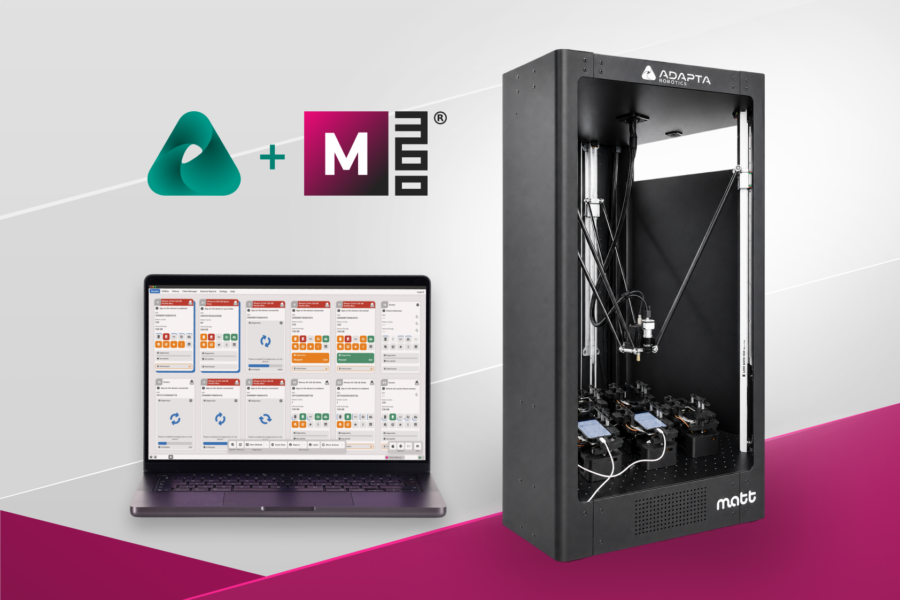
What MATT does is physically interact with devices the way a skilled human technician would – pressing buttons, navigating touchscreens, testing cameras, verifying Face ID, checking charging ports – but with machine precision, full repeatability, and no variability between cycles. It does this through a combination of computer vision, AI-driven workflows, and autonomous mechanical interaction, supported by universal device cradles that accommodate a wide range of device types without any changes to equipment or procedure between models.
MATT is also explicitly software-agnostic. It is designed to be compatible with industry-standard diagnostics platforms – which means the choice of software running on MATT is a deliberate decision based on capability, not a constraint imposed by the hardware.
Up to 2x faster testing on the same hardware
ADAPTA Robotics has integrated M360 into the MATT workflow – making M360 available as the diagnostic software layer on the robot. This is M360’s entry into robotic diagnostics, and the performance difference it delivers on the same hardware is the clearest measure of what the integration is worth.
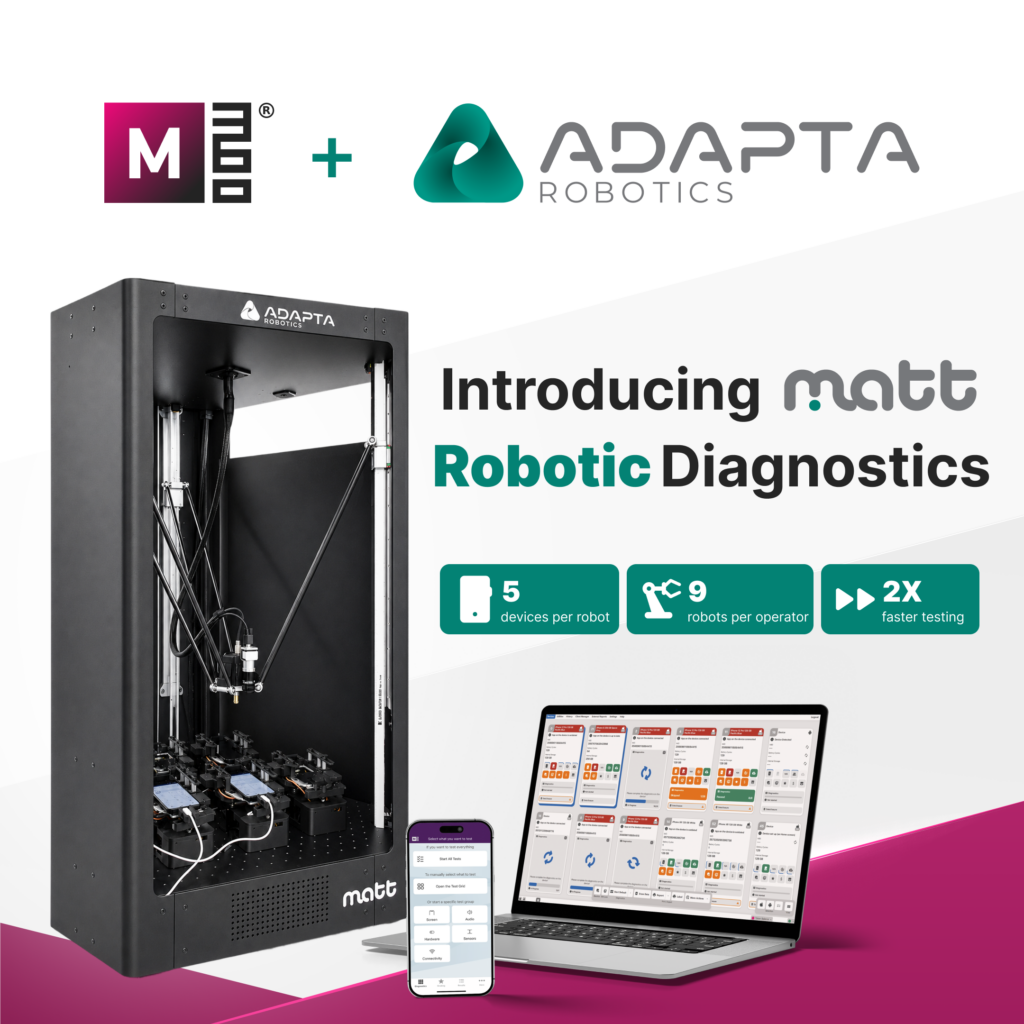
MATT running other diagnostic software, completes a test cycle in approximately 6 minutes per device. With M360, it’s up to 2x faster – the same robot, the same hardware, cutting testing time in half. At any meaningful volume, that difference is not incremental. It is transformative.
At 5,000+ devices a month, cutting cycle time in half means processing the same volume in half the time or processing twice the volume in the same time. At 10,000 devices a month it means the difference between a diagnostics operation that is a bottleneck and one that is a competitive advantage.
The speed improvement is not the only thing the integration delivers. But it is the most immediate and measurable expression of why M360 on MATT is a meaningfully different proposition from MATT on its own.
End-to-end diagnostic coverage
The M360 and MATT integration delivers end-to-end diagnostics coverage across a comprehensive set of hardware and software functions. Every device that goes through the workflow is tested for Face ID, front and rear cameras, SIM call functionality, microphone and speaker, vibration feedback, flashlight, charging ports, touchscreen, side buttons, proximity sensor, RGB accuracy, display anomalies, and LCD and glass condition.
This coverage is delivered through MATT’s software ecosystem – composed of different AI models and classical computer vision approaches, combined with mechanical interaction through the universal cradles – across the full iOS and Android device landscape. Device compatibility spans Apple iPhone, iPad, and Apple Watch on the iOS side, and a broad Android ecosystem including Samsung, Google Pixel, Xiaomi, OPPO, Vivo, OnePlus, Motorola, Sony, Huawei, Realme, Nokia, and more.
Every device that completes the testing protocol receives a full M360 Certification report – a detailed, customisable document showing exactly what was tested, what passed, what failed, and what issues were detected. This is not just an operational output. It is a commercial asset: a standardised, verifiable quality record that supports downstream buyer confidence, grading accuracy, and the kind of transparency that the secondary device market increasingly demands.
One operator, up to 9 robots, 45 devices at the same time
The operational numbers are where the integration moves from a technical discussion to a business decision.
On the MATT Extended configuration, which handles up to 5 devices simultaneously, one operator can supervise up to 9 robots at the same time – with 45 devices loaded and running through the automated diagnostics workflow concurrently. No additional headcount. No retraining between models or brands. No manual handling.
The consistency that comes with full automation is equally significant. Every device goes through the exact same protocol, executed in the exact same way, regardless of which operator is on shift, what time of day it is, or how many devices have already been processed. There is no variability between technicians, no degradation of quality at volume, and no inconsistency between shifts.
Fewer errors means fewer customer returns. Higher consistency means higher resale confidence.
Continuous operation, automatic updates
One of the practical advantages of M360 as the software layer on MATT is how updates are handled. M360 updates deploy automatically – zero scheduled downtime.
This matters more than it might initially seem. A diagnostic system that requires on-site technical intervention every time the software is updated introduces unplanned downtime and coordination overhead that compounds at scale. Automatic deployment eliminates that entirely. The system continues running around the clock, exactly as it should, regardless of what is happening at the software level.
Implementation and commercial model
The solution is implemented through two complementary but independent commercial relationships. Customers lease MATT by ADAPTA Robotics directly from ADAPTA and purchase their M360 software license separately. Both remain independently deployable while enabling seamless interoperability when used together.
On-site installation is carried out by the ADAPTA team. The system integrates into existing refurbishment workflows without major process changes – MATT’s plug-and-play compatibility with industry-standard platforms means the transition does not require rebuilding operational processes from scratch. Ongoing support, training, and consultation are available from both M360 and ADAPTA throughout the deployment.
Availability
Commercially, the two products remain separate: customers rent the MATT Robot from ADAPTA Robotics and purchase their M360 software licence separately. During the pilot period of the ADAPTA lease – max up to six months – the software licence is free, giving operations a full evaluation window before committing. Installation is handled by the ADAPTA team, with support and training available from both companies.
For mid and high-volume operations processing 5,000 or more devices a month, the pilot period is the most straightforward way to put a number on what cutting testing time in half means for their specific operation.
Book a meeting, and we will walk you through both sides of the solution.
FAQ: M360 & MATT by Adapta Robotics
1. What is the M360 and MATT integration?
ADAPTA Robotics has integrated M360 into MATT by ADAPTA Robotics – making M360 available as the diagnostic software layer on their established robotic testing platform. The result is a fully automated, end-to-end robotic diagnostics solution combining physical device interaction with M360’s comprehensive diagnostic software.
2. How does testing time compare?
MATT running other diagnostic software, completes a cycle in approximately 6 minutes per device. With M360, it’s up to 2x faster – the same robot, the same hardware, with testing time cut in half.
3. How many devices can one operator manage?
On the MATT Extended configuration, one operator can supervise up to 9 robots simultaneously with 45 devices loaded and running through the automated diagnostics workflow at any given moment.
4. What functionality does the diagnostic test cover?
Face ID, front and rear cameras, SIM call, microphone and speaker, vibration, flashlight, charging ports, touchscreen, side buttons, proximity sensor, RGB accuracy, display anomalies, and LCD and glass condition.
5. What devices and brands does it support?
iOS and Android across all major brands – including Apple iPhone, iPad and Apple Watch, Samsung, Google Pixel, Xiaomi, OPPO, Vivo, OnePlus, Motorola, Sony, Huawei, Realme, Nokia, and more.
6. What does every device receive after testing?
A full M360 Certification report showing every check run, passed, failed, and any detected issues.
7. How does M360 handle software updates?
Automatically. Zero scheduled downtime, no version management required from your team.
8. What is the commercial model?
Customers lease MATT directly from ADAPTA Robotics and purchase their M360 software license separately. Both are contracted independently but designed to work together seamlessly.
9. Is there a trial period?
Yes. For the duration of the ADAPTA lease trial period – up to six months – both the MATT lease and the M360 software license are available at no cost.
10. What volume does this make sense for?
Operations processing 5,000 or more devices a month. The system is designed and tested for mid to high-volume operations, with the strongest ROI impact at 8,000 to 10,000 devices per month.
11. How does implementation work?
On-site installation is carried out by the ADAPTA team. The system integrates into existing workflows without major process changes, with ongoing support and training available from both teams.