You can process a thousand phones a week, grade them perfectly, price them right and still lose a major B2B account because you couldn’t prove the data was gone. ADISA-certified data erasure is how serious operators close that gap. Here’s what it actually means, why enterprise buyers care, and how to make it part of your workflow before it becomes a problem.
What ADISA-certified erasure actually means
ADISA – the Asset Disposal & Information Security Alliance – is an independent body that certifies data erasure processes and tools against verified technical standards. When an erasure method carries ADISA certification, it means a third party has tested and validated the process. Not the vendor. Not a marketing team. An independent auditor.
“Secure wipe” is a phrase any software product can use – it has no regulated meaning. ADISA accreditation is different. It means an independent body has tested and signed off on the method, the tooling, and the process around them. For B2B operators, that’s the kind of credential that stands up when a corporate buyer’s IT security team starts asking questions.
Worth noting: the certification doesn’t just cover the software. Inconsistent workflows can undermine even accredited tools, which is why process matters as much as the product itself.
Factory reset vs. certified erasure – stop mixing the two
This is where a lot of operators are unknowingly exposed. A factory reset removes the file index – it’s essentially telling the operating system to forget where the data is stored. The actual data? Still there, in the storage, until something writes over it.
With widely available recovery tools, data from a factory-reset device can frequently be retrieved. This isn’t theoretical. It happens.
Certified erasure works differently. It overwrites storage to a defined technical standard – multiple passes, verified completion – and generates a record proving the process ran successfully. That verification step is everything. Without it, you have no defensible evidence that a wipe ever happened.
Here’s the scenario that should keep you up at night: a corporate client buys 500 phones from your inventory, one lands in the wrong hands, and a contact list from a former employee surfaces. That single incident can end a supplier relationship, trigger a regulatory complaint, and follow your business for years. A factory reset won’t protect you. A documented, certified erasure process will.
The legal and commercial reality of getting this wrong
Data protection law – GDPR in the UK and EU, and equivalent frameworks in other markets – is unambiguous on one point: whoever last holds a personal data-bearing device is responsible for ensuring that data is properly disposed of. When you buy corporate stock – trade-ins, bulk buybacks, lease returns – the data liability transfers with the hardware.
The exposure runs in two directions. Legal risk is real but often slow-moving. Commercial risk hits faster. Enterprise procurement teams are increasingly requiring documented proof of data erasure before completing purchases. Some now make it a contractual condition. If you can’t produce the paperwork, you don’t make the sale – it’s that simple.
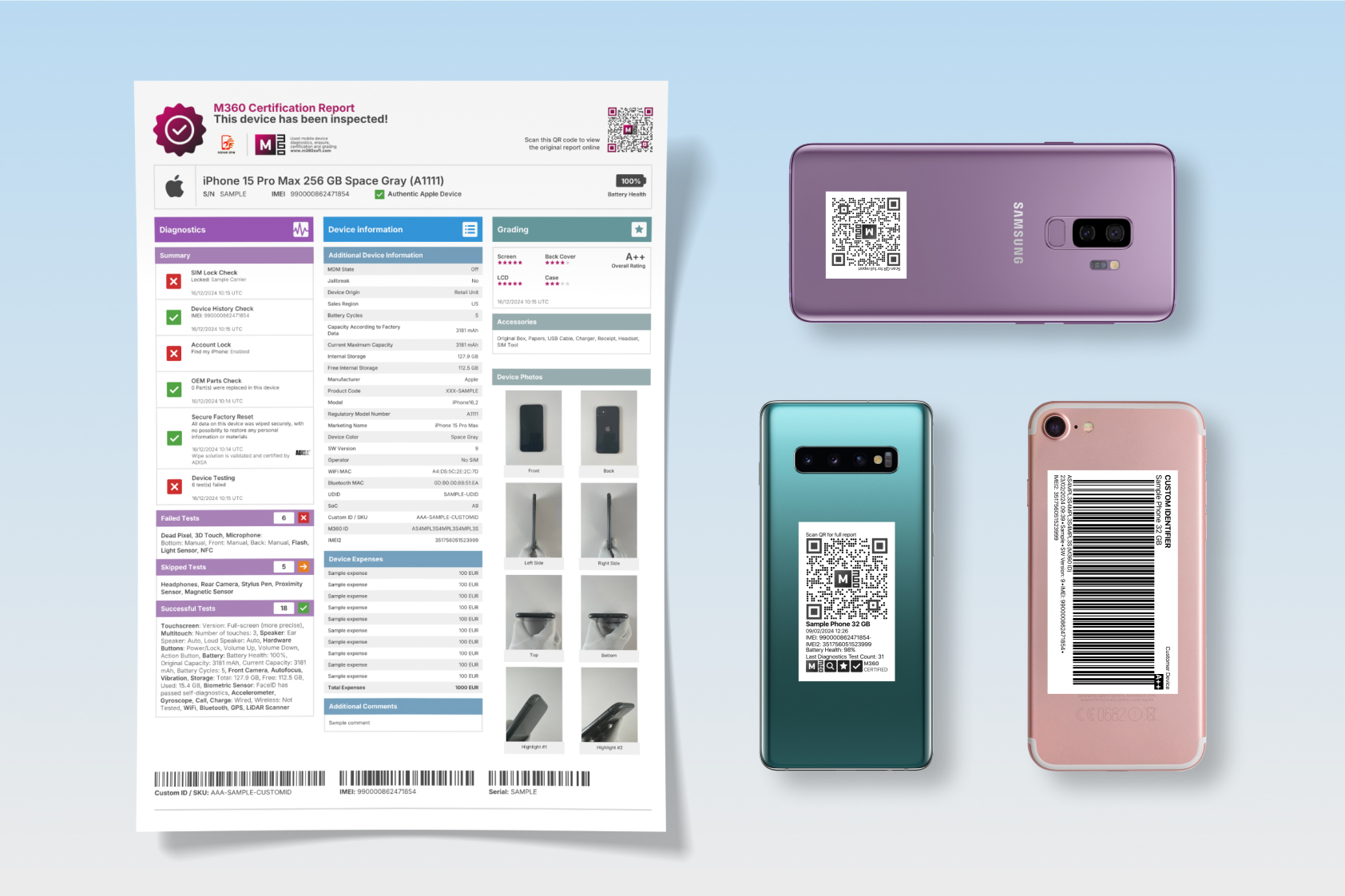
M360 Diagnostics generates exportable certification reports that give buyers documented proof of data erasure for every device in a batch. That’s not a nice-to-have feature. For operators chasing enterprise accounts, it’s what gets you in the door and keeps you there.
Who actually needs to be paying attention
The honest answer: any operator whose inventory ever touched corporate hands.
High-volume resellers selling to business buyers. Refurbishers processing corporate trade-in programmes. Recommerce platforms with enterprise procurement clients. Operators sourcing from carriers, leasing companies, or IT asset disposers. The common thread is corporate stock and corporate stock comes loaded with data risk that consumer sourcing can obscure.
To be clear: the obligation to erase data properly applies regardless of where a device came from. A private individual’s contacts, photos, and banking apps deserve the same standard of erasure as a former employee’s work files. GDPR makes no distinction.
The difference is commercial pressure. Enterprise buyers will ask for documented proof of erasure. Increasingly, they’ll make it a contractual condition before completing a purchase. Consumer buyers rarely do, but that doesn’t make the underlying obligation any lighter.
The operators building proper erasure capability now are the ones who’ll be positioned to take the accounts that others lose over this exact issue. And they’ll be running a cleaner operation across the board, regardless of where their stock comes from.
Where certified erasure fits in your workflow (and why it can’t be manual)
Erasure belongs at the front of the process – right after intake, before detailed diagnostics, before grading, before anything else. If a device goes through your full refurbishment workflow with data still on it, you’ve already taken on risk you didn’t need to.
Doing this manually at scale is not a workable answer. Wiping 200 or 300 devices a day, confirming each one, and logging every result individually is a staffing problem masquerading as a process. The only sustainable model is automation.
M360 Diagnostics makes data erasure simple to run at scale. Operators can wipe devices individually or in batches, with M360 generating a timestamped erasure certificate for every device automatically. Those reports are exportable and ready to share with buyers at the end of the process.
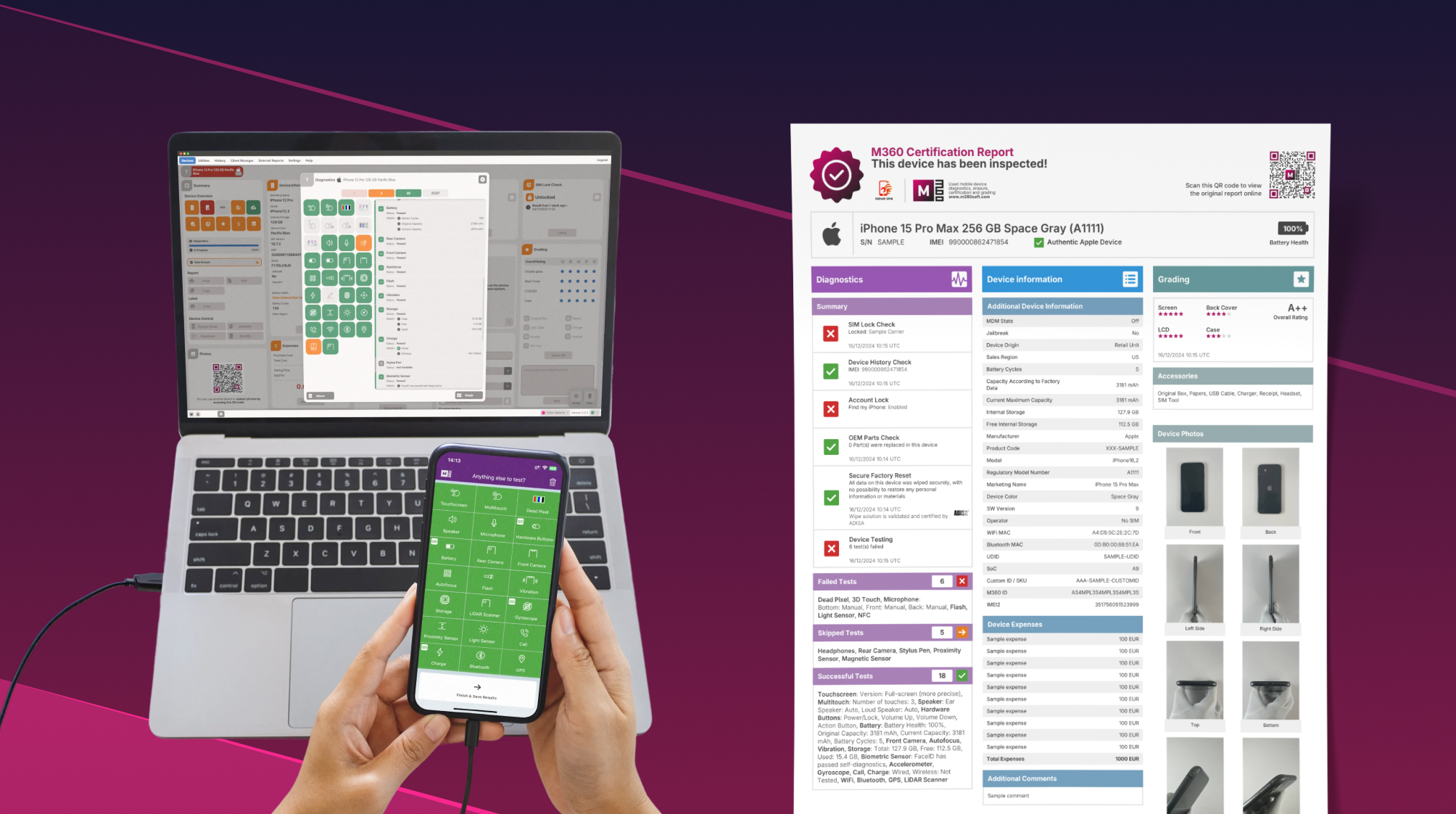
Because erasure sits inside the same workflow as functional diagnostics, IMEI and blacklist checks, and grading, everything is documented in one place rather than spread across separate tools with a fragmented audit trail.
That’s the operational difference between a platform built for volume and a collection of tools bolted together.
What to actually look for in a certified erasure solution
The market is full of products claiming “secure erasure.” Most of them mean something quite different from ADISA certified. Here’s how to cut through it.
Independent accreditation – not vendor language. Ask whether the method has been independently tested and by whom. If the answer is “we tested it internally,” that’s not certification.
Timestamped, exportable certificates per device. A batch-level log is not the same as a per-device certificate. Enterprise buyers will ask for individual records. Make sure your solution produces them.
Full iOS and Android coverage. Android erasure is more complex than most operators realise — FRP locks, USB restrictions, and manufacturer-level security settings on devices like Xiaomi can all get in the way. iOS follows a more standardised path. A reliable solution needs to handle both consistently, with the same documentation at the end, regardless of which OS you’re processing.
Batch processing capability. If every device requires individual manual steps, your erasure workflow will become the slowest part of your operation. It doesn’t scale.
End-to-end integration. If erasure lives in a separate tool, it creates a separate audit trail and gaps between systems are where documentation problems happen. M360 keeps erasure, functional testing, grading, IMEI checks, and certification reporting in one place, so everything is exportable together in a single report. And through integrations with WholeCell, Phonilab, RepairDesk, ResellSync and others, that data flows straight into the platforms you’re already running your business on.
Three questions to ask your current provider right now
Before assuming your existing setup has you covered:
- Does the tool generate a timestamped certificate per device, or just a batch summary?
- Is the erasure standard explicitly documented?
- Can reports be exported in a format your buyers will accept without pushback?
If those answers aren’t clear, you’ve identified the gap.
This is an opportunity, not just a compliance box
Here’s the framing shift worth making: ADISA-certified erasure isn’t purely defensive. The operators winning the best B2B accounts are the ones who can put documentation in front of a procurement team and say – here’s exactly what we do, here’s the proof it happened, here’s the certificate for every device in this order.
That’s a sales asset. It shortens procurement conversations. It removes objections before they’re raised. And it builds the kind of supplier trust that makes clients sticky.
The used phone market is maturing fast. The operators who treat compliance infrastructure – certifications, audit trails, documented processes – as a competitive advantage are going to pull ahead of those still treating it as overhead. M360 Diagnostics is built for operators ready to make that move, at the volumes that actually matter.
FAQ: ADISA certified data erasure and why it matters for used phone businesses
1. What is ADISA-certified data erasure?
ADISA (Asset Disposal & Information Security Alliance) is an independent body that accredits data erasure processes and tools against verified technical standards. ADISA certified data erasure means the method has been independently tested – not just self-declared – to confirm that data is irreversibly removed from a device. For used phone businesses, it provides a defensible, documented standard that goes well beyond a factory reset.
2. Is a factory reset enough to wipe a phone before resale?
No. A factory reset removes the file index but often leaves the underlying data intact on the device’s storage. With the right recovery tools, that data can frequently be retrieved. Certified erasure overwrites storage to a defined standard and verifies the process completed – creating a documented record that a factory reset cannot provide.
3. Do used phone resellers have a legal obligation to erase data?
In most jurisdictions with data protection legislation – including GDPR in the UK and EU – whoever last holds a data-bearing device is responsible for ensuring personal data is properly disposed of. Resellers who process corporate trade-in stock are particularly exposed, since those devices commonly contain employee and business data. Certified erasure with documented proof is the most defensible way to meet that obligation.
4. What is M360 Diagnostics, and what does it do?
M360 Diagnostics is a platform built for used phone resellers, refurbishers, and recommerce operators. It automates device diagnostics, IMEI and blacklist checks, data erasure, grading, and certification reports – typically across large batches of devices. M360 generates exportable certification reports that operators can share with buyers as documented proof of device condition and data erasure.
5. Can M360 generate certification reports for data erasure?
Yes. M360 Diagnostics produces timestamped, exportable certification reports for each device processed through the platform – including data erasure records. These reports are designed to give B2B buyers documented evidence that devices have been properly wiped and can be stored for audit purposes.
6. What’s the best software for bulk data erasure in a phone refurbishment business?
For refurbishers and resellers processing high volumes, the most practical solution is a platform that integrates data erasure with the rest of the diagnostics workflow – rather than a standalone wipe tool that operates separately. M360 Diagnostics handles erasure as part of batch processing alongside functional testing, grading, and certification, which reduces manual steps and keeps audit documentation in one place.
7. Does M360 Diagnostics work with both iOS and Android devices?
Yes. M360 Diagnostics supports both iOS and Android devices, covering the full range of handsets a typical reseller or refurbisher would process. The platform handles diagnostics, erasure, grading, and certification across both operating systems within the same workflow.